Showing posts with label Paul Muldoon. Show all posts

Tuesday, January 22, 2013

Top 10 Snow Poems

Britain shivers, but also - whatever Mr Osborne says - gleefully skives for a few snowy days. Since the only thing better than an autumnal poem is one about snow, here's my top 10 wintery favourites. In order of my thinking of them, not in order of preference.

1. 'Snow' by Louis Macneice

An obvious choice, I know, but the snow poem all other snow poems now have to nod in the direction of.

2. 'History' by Paul Muldoon

Okay, getting off topic already - but this surely has to be the best response to Mcneice?

3. 'Snow' by David Briggs

A poem about words for snow, and how the wonder is as much in the words as in the snow.

4. 'Snow-Flakes' by Henry Wadsworth Longfellow

Snow as 'the poem of the air'.

5. 'Snow Melting' by Gjertrud Schnackenberg

Snow melts to reveal a world without love.

6. 'Stopping by Woods on a Snowy Evening' by Robert Frost

One of the best-known poems by any American poet. And the Fozzie Bear rendition is pretty good, too.


7. 'The Buck in the Snow' by Edna St. Vincent Millay

An uncanny, almost symbolist poem - frustrated desire and failed communication.

8. 'Slush' by Alan Buckley

A poem about the loss of growing up that also tackles the theme of climate change in a subtle and personal way.

9. 'Snow Water' by Michael Longley

Imagine drinking the purity of snow.

10. 'Snow and Snow' by Ted Hughes

The sensuality of snow in Hughes' transformative imagination.

I'm sure other people have their favourites - maybe some I don't know. Why note share them with a comment on the blog?

Friday, December 28, 2012

Reading the Poet

Really, I should follow the lead of many illustrious poetry bloggers and offer this final post of the year as an overview of what has been and what is to come. But two reading experiences in the latter months of 2012 have set me thinking, and the following - rather than an end of year thought - is more of an ongoing thought about how we read poetry.
It has been a while now since Roland Barthes declared the 'death of the author', liberating literary criticism from the quest to reconstruct what the author 'really meant' or to uncover the hidden meaning of the text in her or his biography, but poetry like any other art form is intrinsically bound up with the facts of the maker's life, at least from the reader's point of view. Would any reader really approach Plath or Larkin without wanting to find out something about who they were, even if that only went as far as tapping their names into Wikipedia? The fact that standard editions of poets' works are incomplete without some kind of biographical sketch and an apparatus of notes filling in the details of the author's movements and acquaintances suggests otherwise.
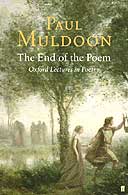
The End of the Poem by Paul MundoonPaul Muldoon's Oxford poetry lectures, published in The End of the Poem (2006), are much preoccupied with the relationship between the work of reading and interpreting and the work of writing. One of the questions that Muldoon asks is, where does the poem end and its author begin? How can the poem survive without the context of the author's biography? (I'm thinking here particularly of the chapter on Lowell). The interpretative process which Muldoon's lectures enact is unconventional in contemporary academic terms: he picks up on certain words or plays on words between the poem he analyses and a broad range of material which, his readings assert with a certain ironic twinkle of the eye, must have informed the creative process of the poet in question. Sometimes this seems likely, sometimes little more than hypothetical, if always fascinatingly so. To my mind, what Muldoon is really about is constructing an 'implied author', in much the same vein that academic literary criticism once sought to construct an 'implied reader' from the text. Ultimately that author is only one who exists in the connections Muldoon himself makes, the readings he fashions; but those readings are akin to a writerly process in which the reader reimagines the original act of creation, a process not unlike that of translation as described in one of Muldoon's lectures. The paradox Muldoon presents to us is the necessity of the author for our engagement with the poem, faced with our own construction of that author in the act of reading.
The other book that has provoked me into thinking about the role of the particular personality of the poet in the reading process is Jan Wagner's Die Eulenhasser in den Ellenhaeusern (2012), a collection that - I realise - will remain inaccessible to many people who will read this post. Wagner is to me one of Germany's most interesting poets, possessed of a keen awareness of form and a lyrical approach, doubtless informed by his work translating contemporary English verse. He stands somewhat apart in German poetry today, dominated as it is by a hermetically modernist approach in the tradition of Celan. However, Die Eulenhasser can rightly be described as an 'experimental' book. Wagner presents himself as merely the editor of a collection of work by three obscure (or 'hidden') poets, two deceased and one anonymous. One is an 'untrained' rural poet, one an avant-gardist who writes only anagrammatical poems, the last writes 'Roman elegies' in the tradition of Goethe. The poets are presented with copious notes, biographical essays and a list of secondary literature - all of which, it gradually dawned on me - is entirely fake. The only author at work here is Wagner himself.
What Wagner is up to here may seem like showing off, demonstrating his versatility. And all of the poems are good, I think, sometimes very good, so this is not just an exercise in fakery. While enjoying the poems, however, I found my psychological relationship to the book unsettling. Particularly the first of Wagner's poets, the farmer Brandt, is so affecting not only because of the skill with which Wagner has given him a unique voice, but also on account of the very authenticity from which such voices live - an authenticity we realise to be entirely spurious. Although I would not want to reduce Wagner's achievement to this one point, I find a link to Muldoon's poetry lectures, in that text allows us to imagine three fantastical poets in much the same way as we would imagine the 'real' poets whose work we read. Imagining such poetic identities, both Muldoon and Wagner seem to suggest, is inseparable from the reading process. This modifies Barthes' obiturary for the author considerably. The philosopher had also argued that the creator of any work was only the sum of the texts by and about her or him, onto which the reader projected a personality. What Muldoon and especially Wagner add is the insight that knowledge of this state of affairs does not mean that we can stop reading for that personality, even when we know that it is a (pleasurable) fiction.

Monday, July 2, 2012

Break it down

At a recent poetry workshop I attended in Bristol, a writer new to poetry asked the organiser to explain why poets use line-breaks the way they do. Not an easy question to answer.

Lineation seems obvious enough when a poem has a regular metre, and especially if end-rhymes are used, but how to explain what poets are up to when they use other principles to break their lines? The obvious answer, I suppose, has to do with the rhythm and weight of the individual lines, but I've heard claims for all kinds of other allegedly hard and fast rules: for instance, the suggestion that line-breaks are a substitute for punctuation, that they somehow stand in commas (surely piffle to anyone who has actually read contemporary English-language poetry). I prefer to think of line-breaks as a conventional feature of verse which doesn't have a function per se, but which can be made to do all kinds of things.

Here's a list of my top five things to do with line-breaks, not necessarily in order of importance - I'd be happy to hear some more...

1. A line-break can suspend meaning, or even give us two (or more) meanings for the price of one.

For example, in Alasdair Paterson's poem 'Dome' (from his pamphlet Brumaire and Later, 2010), a description of a space where a cathedral used to stand begins as follows:

The park's quiet
where the cathedral was.

Seems simple enough, but we can see how the line-break create ambiguity. It forces us to read 'the park's quiet' at first without reference to what follows. We could read it as 'the park is quiet' or 'the quiet of the park', both meanings being possible until we have the following line, which pins things down more closely to 'the park is quiet'. But the second meaning ('the quiet of the park') does not just cease to exist as a possibility, and this notion of the 'the park's quiet' as some particular kind of quiet that is specific to the park, a quiet which becomes almost a tangible thing in itself, still echoes.

2. A line-break can surprise

Th value of surprise in poetry is severely undervalued. But who wants to read a predictable poem? Line-breaks create surprise by allowing out thoughts to move in one particular way, only to make them shift into some other direction. The example from Paterson's 'Dome' is a good one for surprise, too. First we have the perhaps rather banal statement that the park is quiet. Perhaps we are expecting one of those nice nature poems. Perhaps there will be swans alighting on a silvery pond. And now, all of a sudden, we have the idea that a cathedral used to be here. Since when did cathedrals use to be anywhere. Surely they are the kinds of things that stay built, massive as they are? How much more surprising this notion seems because of Paterson's use of the line-break. If his poem had begun 'The cathedral used to stand in the park' (which would make a much inferior poem) we would not even be invited to see this as a surprising idea.

John Burnside is a real master of the many possibilities of the line-break, and often uses them to make imagery more surprising to the reader. For example, in his poem 'Nativity' (from Black Cat Bone, 2011), the narrator describes his birth:

and I lie squalling in a slick of blood
and moonlight [...].

Blood and moonlight is an unexpected combination (although Burnside is doubtless drawing on ancient associations of femininity, fertility and the moon), but the line-break makes the image much more striking. We take in the fairly naturalistic 'slick of blood' only for the next line to then reveal a further element which unsettles the image we have already established in our minds.

3. A line-break can suggest movement or distance

In the same poem, Burnside gives us an instance of the line-break that suggest physical movement or distance of some kind, when he describes lights going out

in house after house, from here
to the edge of the world [...].

In that line-break, we can almost feel the gesture, as if the poem was pointing and making us feel that difference between the here and the unimaginably far away.

4. A line-break can make strange

There is a widely-held view that line-breaks should not break up the sense of an expression so that it wrong-foots the reader. I think what the reader really needs is wrong-footing. To poets I say, 'come on - wrong-foot me, give it your best shot.'

Paul Muldoon and Matthew Caley do this a lot. In Muldoon's case, there is often a very deliberate strategy of fragmenting the sense of an expression over several lines so that the reader is constantly having to reorient themselves. The individual lines frequently don't make much sense standing alone. In a way, this is a similar process to no. 1 (suspending meaning) but carried to such an extent that language becomes a strange material the reader has to struggle with rather than simply the opaque medium of some easily-digested meaning. So, for example, in his recent collection Maggot (2010), we can read the following in 'The Humours of Hakone':

[...]  I'd read somewhere that the Japanese love of kitsch
is nowhere more
evident than in the craze for these sticker-photo booths which

go even further to reinforce
not only the heels of a panty hose worn under a kimono
but the impression that phosphorous
might still be a common element in flash photography. Dead
     common.

There's a kind of stop-start quality to this I like - we get drip-fed bits of meaning which slowly accumulate.

Matthew Caley often does this making strange using hyphens to break up otherwise common words over more than one line. In his poem 'Elbow', for instance (in Apparently, 2010 - not sure why most of my examples were from 2010 - must have been a good year for line-breaking), he describes

the entire audience, vibrat-
ing life the F-holes of a cello [...]

Apart from making the word 'vibrating' seem very odd (like when you say a word you know over and over until it seems arbitrary and strange), there's a great joke here, too. The word 'vibrating' itself seems to, well, vibrate.

Despite my use of recent examples, this kind of thing has been around since Modernism at least. You can see all of these things happening in e.e. cummings, for one (as in 'Poem, or Beauty Hurts Mr. Vinal').

5. A line break can be funny

While we're on the subject of humour - I love a good line-break joke. Maybe we're getting into the realms of  concrete poetry here, but let's finish with A. R. Ammons' rid-tickling two-liner 'Their Sex Life':

Their Sex Life

One failure on
Top of another

***

Well, that's my personal top five things to do with a line-break. If there's one thing a line-break should not do, though, it's to

fool us into thinking
that because we have added
line-breaks to what is essentially
prose, we have written poetry.
Because we haven't.