Sunday, March 23, 2014

Guest Poet - Jonathan Edwards

I first met Jonathan Edwards a couple of years ago on a Poetry School course run by David Briggs in Bristol. Jonathan's poems immediately captured the imagination of everyone in the group. The warmth and wit of his work is balanced perfectly with a precise sense of craft. His first full collection, My Family and Other Superheroes, which has just been published by Seren, is a triumph. Moving and audacious, Jonathan's vision is shrewd without being harsh, surreal yet grounded in the world we all share. This is poetry that believes in seeking out the truth in the ordinary, its flights of pop-culture-inspired fancy always bringing us back to the bedrock of what makes us who we are. This is especially the case in the wonderful 'Evel Knievel Jumps Over my Family', which is featured below as a guest poem.

Jonathan has this to say about the poem:

"I work as a teacher and sometimes, when they’re not asking me why they have to do the homework, or why they have to study this book for GCSE, or even why the sky doesn’t have orange polka dots in it, my pupils have been known to ask an interesting question: where’s the best place to write a poem? I think they’re expecting me to say something like ‘In a rose-lined arbour in high summer, as bees buzz their ideas round your ears, and all your senses tingle’ or, ‘On a hillside at night overlooking a city, as the silhouettes of office buildings and smokestacks form their ghostly backdrop to the nightingales’ song.’ Instead, my answer is usually the same: sitting on the sofa, during the advertising break in The Simpsons.

The Simpsons is a gift for anyone wanting to write the comic, pop culture surreal – the kind of work that grows out of Jo Shapcott poems like ‘Superman Sounds Depressed,’ or ‘Tom and Jerry Visit England,’ or the wonderful sonnet sequence by the American poet David Wojahn, ‘Mystery Train,’ which explores a series of apocryphal but plausible moments in pop culture. There’s a sonnet about Francis Ford Coppola teaching Philippine tribesmen the lyrics to ‘Light My Fire’ on the set of Apocalypse Now, for example, and another about the time Delmore Schwartz went to a Velvet Underground gig. It’s difficult to look at the plot synopsis of a Simpsons episode, or even a single frame, without getting a bunch of ideas for comic and surreal poems which also – and this is the crucial thing – get to something which matters. The surreal as a way of getting to the real – that’s the thing for me.
With ‘Evel Knievel Jumps Over my Family,’ the episode of The Simpsons in question was an early one, where a character clearly based on the real-life daredevil 70s motorcyclist inspires Bart to try and jump Springfield Gorge on his skateboard – something which Homer subsequently does instead, to try and win over his son. This reminded me in turn of an Evel Knievel action figure I had when I was a kid and would launch across the room, having him risk his plastic life by leaping candlesticks, coffee tables, toy giraffes. From there I was off. What could Evel Knievel say about my family? What if Evel Knievel jumped over my family? How would my mother feel about that? My great-grandmother?

A very eminent poet once told me that if I wrote poems about my family, they would only be of interest to my family. But if there’s a more important reason to write poems than the people we love, I don’t know what it is. Evel Knievel, as he soars through the air, is my solution to that problem. Throw famous people at a poem and you might also be throwing readers. The poem forms part of a sequence of similar surreal approaches to the family at the start of my Seren collection, My Family and Other Superheroes. I’ve yet to write a poem set in a rose-lined arbour in high summer. But if I ever do, I might well-find that two figures come zooming through it: a boy on a skateboard, dust rising from his wheel-tracks, being chased by his balding, beer-bellied, and strangely yellow dad."


Evel Knievel Jumps Over my Family

A floodlit Wembley. Lisa, the producer,
swears into her walkie-talkie. We Edwardses,
four generations, stand in line,
between ramps: Smile for the cameras.

My great-grandparents twiddle their thumbs
in wheelchairs, as Lisa tells us to relax,
Mr Knievel has faced much bigger challenges:
double-deckers, monster trucks, though the giraffe

is urban legend. Evel Knievel enters,
Eye of the Tiger drowned by cheers,
his costume tassels, his costume a slipstream,
his anxious face an act to pump the crowd,

surely. My mother, always a worrier,
asks about the ambulance. Evel Knievel
salutes, accelerates towards the ramps.
I close my eyes, then open them:

is this what heaven feels like,
some motorcycle Liberace overhead,
wheels resting on air? Are these flashes
from 60,000 cameras the blinding light

coma survivors speak of? Before he lands,
there’s just time to glance along the line:
though no one’s said a thing,
all we Edwardses are holding hands.

Thursday, March 20, 2014

And they're off!

The first event of this year's Cheltenham Poetry Festival took place last night - and what a corker it was!

The Cheltenham Improvisers Orchestra provided a wash of ambient sound - created live with synthesizer, bassoon, drums, cello, electric bass, household items and even a ping-pong bat and ball - over which poets read their work about spring. A whole range of styles was on offer - the combination of so many different voices with the lush and inventive soundscapes made for a mesmeric experience.


There are so many good things on offer over the coming weeks, and the standard is already high. You can see more of the programme and book tickets here.

Saturday, March 15, 2014

States of Independence

States of Independence is an independent publishers' fair held annually at De Monfort University in Leicester, home of one of the region's liveliest creative writing programmes. I've been meaning to get along to it for a couple of years now, but have now finally had the time to make the trip. It was well worth it. Apart from the all too-tempting book stalls (see my haul of purchases below...), the readings and discussions were some of the most stimulating I've experienced for a long time.


Sadly, it was impossible to attend everything on offer, but here are some impressions of the events I was able to see.

The morning began promisingly with 'The Poetry of Sex', presented by four poets recently included in Sophie Hannah's controversial anthology of the same name from Penguin. Although some of the participants had mixed feelings about the anthology itself, their poems, and the discussion afterwards, threw up lots of interesting questions about what sex in poetry could be about, apart from being about sex itself. Rich Goodson's impressive prose poems drew on mythology and theology to present sex as a transformative and potentially subversive force, whereas Cora Greenhill's poems explored the gender politics in various sexual encounters. Gregory Woods reflected on the place of depictions of gay sex in the fight for equality, and Maria Taylor's poems discussed sexuality in the context of her Greek Orthodox upbringing.

In the next session, Peter Hughes of Oyster Catcher Press presented three pamphlet poets: Alan Baker, Kathleen Bell and Sarah Crewe. Baker's wry collages of everyday thoughts and perceptions produced a restrained lyricism, while Bell's elliptical, fragmentary work was particularly effective in a sequence on the drowning of immigrants at Lampedusa. Here the poet drew on tales of legendary European travelers to weave a complex inter-textual fabric, which was political without being polemic. Sarah Crewe, who had traveled from Liverpool, delivered a blistering performance of highly original 'working-class, feminist psychogeography', then fairly brought the house down with a sequence of poems which re-imagines Steven Spielberg's Jaws from a feminist perspective. Her re-appropriation of pop culture (including the Thundercats) to political ends was witty and compelling.

At one o'clock, a full room was treated to a reading by Roy Marshall and Rory Waterman, both of whose debut collections came out last year. Marshall and Waterman both often write ostensibly 'personal' poetry (family plays a significant role), but they also have in a common a precision of expression and brilliant handling of imagery (especially of the natural world) which I very much admire. Waterman's book, Tonight the Summer's Over, is perhaps more melancholy than Marshall's collection, but certainly a worthy Poetry Book Society recommendation.

The final event I attended was hosted by Bold Strokes Books, an LGBTQ publisher, who had invited a panel of authors along to talk about the extent to which LGBTQ literature needs to move out of the ghetto of the bookshop's 'gay and lesbian' section. There was a strong feeling in the room that the community (or possibly communities) still needs and wants books for themselves, but there was also an unresolved tension with the desire among authors to write what they chose without being bound to represent a particular group, and to have their writing read by a wide spectrum of people. The relatively brief discussion was never going to resolve this issue, but it was good to hear the conversation carrying on in the corridor afterwards. Also, it was fascinating to find out about developments in LGBTQ publishing in recent years which had passed me by.

In between all of this, there was a chance to chat with publishers, magazine editors and many familiar faces, including Jacqui Rowe of Flarestack. On the train ride home, in the spring sunshine, I was already beginning to read the book purchases I had filled my bag with.

Monday, March 10, 2014

Guest Poet - Daniel Sluman

I'm very pleased to have secured Daniel Sluman for a guest poet slot on this blog - the next in an as yet rather irregular, but hopefully increasingly regular series. I reviewed Daniel's first collection, Absence Has a Weight of Its Own, here a little while ago, and am very much looking forward to reading his second book. The poem below, which Daniel introduces himself, is from that new work. As is typical of Daniel's writing, this poem combines a frank tone with an artfulness and an arresting use of imagery that are all his own.

Daniel writes:

'One of the things I hate the most in contemporary poetry is the potentially lazy use of "poem" as a title. When the title is there for you to lift open a new ambiguity or show a different side to the piece,why waste that by telling the reader, simply that this is a "poem." Well, I broke this rule of my own because this poem in itself is about writing other poems, and contained a kind of meta angle that made it impossible for me to call it anything else.

As for the poem’s content, it’s typical of the confessional approach I used in my debut, and am refining, for what is currently known as #difficultsecondcollection on my twitter feed, to be published by Nine Arches Press at a later date . I have very mild OCD, which includes counting whilst opening doors, and turning light-switches off a certain amount of times (9 to be exact…) but this also included a stage where I would check the locks on the front door each night even when I was aware that I had locked them only ten minutes before. When I suddenly stopped this trait, I wrote it down in my notebook as I thought the idea of it could be seen to have a potentially deeper emotional reason behind it for the reader.


My then partner, Sonia Hendy-Isaac, who is herself a fantastic poet, and whose debut is out soon, appears in the poem as the female character.  She always looked at my poems before anyone else did. As someone who is always willing to turn his life into art, there are deeper connotations when that life is one you share with someone else and I felt at times that maybe Sonia gleaned ideas about my perception of the relationship, or was uncomfortable with how much I was willing to reveal about our lives on paper when she read these drafts. So that’s how the poem came about; quite typically for me, a collision of two ideas - this OCD act which I felt had deeper emotional connotations, and how someone else felt about showing the public our shared life bare to the world, this is how "Poem" came to be.'


Poem

For four years I’ve wanted to end this poem 
with    why have I stopped checking the locks 

at night       but as I part the pile-up 
of crash-red hair that slips over your scalp   

I understand the world only gets fuller
with the breaking of it      the smooth keys 

of your breath fill my shaking hands     
& we have never had as much blood 

in our bodies as we do now      you     
waking to read this draft       your face 

changing in the light of the laptop  
as you tell me to avoid repetition    

you count  the nouns      but worry 
is the grit in your eye     why do you wince 

when you read this poem       & why 
have I stopped checking the locks at night

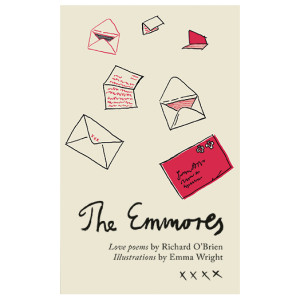
Richard O'Brien's The Emmores

I have a review of Richard O'Brien's pamphlet The Emmores from The Emma Press over at Sabotage Reviews.

Sunday, March 2, 2014

Cheltenham Poetry Festival Preview


The team at Cheltenham Poetry Festival have done a fine job again this year in putting together a wonderful selection of big names, rising stars and local writers (many of whom also fit happily into those first two categories!). I'm particularly looking forward to seeing the launch of Anna Saunders' new collection Struck, David Briggs reading with Don Paterson, the lunch of Mikki Byrne's Flying Through Houses, Sujata Bhatt, Sophie Hannah, Ruth Padel, and the swinging poetry band Little Machine (I'm especially hoping to hear their version of Larkin's 'This Be the Verse' again). There are also fascinating events about Dylan Thomas, Laurie Lee and the Dymock Poets, as well as showcases for excellent younger poets from the University of Gloucestershire.

The festival previews on 22-23 March, then gets into full swing from 28 March until 6 April. You can download the festival brochure and book tickets at their website.

In all modesty, I should also mention that you can see me reading on no less than three occasions: first with Jennie Farley and Chris Hemingway at an event we are calling 'Myth, Music and Memory' on 30 March at 12.30 in the Oxfam Bookshop;on 5 April with the Poetry Factory in The Strand, 20.00-21.00; finally, on 6 April, 11.00-12.00 in Taylors, with the Flarestack Poets showcase. Further details in the brochure.

Tuesday, February 25, 2014

Blogging Tour

Roy Marshall has kindly asked me to take part in a 'blogging tour' - basically a chain of blog posts by poets on a series of shared questions. I'm a little bit behind with getting my post done, and haven't yet found enough people to add to the chain myself, so I'm already feeling a little inadequate. Hopefully there isn't a curse for messing it up, like with those chain letters people used to send through the post! Anyway, to get an idea of what others have been writing, you can follow the chain back to Roy's post here.

The four questions I have to answer are as follows:

1) What am I working on?

At the moment, nothing. I haven't written anything in weeks, but that's not unusual. I have to write for my work (certainly not poetry) and I also write reviews, as well as posting stuff on this blog, so I never feel I'm not writing something. Nevertheless, sometimes the poetry part of my brain just switches off for a while. I suppose if I was a full-time poet, I'd develop some tricks for getting myself out of the rut, but as I have other things going on too, I just devote my attention to those until I come across something I have to write about. This may be why I have never entirely gotten on with workshops, although they can be great fun. Writing to a prompt or in response to an exercise makes me feel like I'm writing something that doesn't really need to be written, or that I don't need to write, to be more precise.

In the broader scheme of things, I'm secretly working on first collection of poetry. Well, not so secretly now. I haven't secured a publisher as yet (I'm sure the phone will start ringing at any moment), but I've suddenly arrived in a place where, when I finish a poem, I think is that going in the collection? Not that I feel like any cohesion is beginning to emerge as yet, but the thought of a first collection is making me want to write bigger, more ambitious pieces.
2) How does my work differ from others of its genre?
As I've said elsewhere, what really intrigues me about the process of putting my poetry out there into the world is that other people have a much better sense of what it is that I do, and what distinguishes what I do from other people's work, than I could ever have. A lot of the time, I'm actually trying to be like other poets whose work I think is much better, and failing.

3) Why do I write what I do?
I think poetry can say anything. I'm always a bit surprised when people think that I've touched on a difficult subject, because it never occurs to me that anything should be off limits. Poetry is a realm of absolute freedom. Having said that, most of my poems are fairly harmless, but I do like that feeling that poetry can go anywhere. I am braver in poetry than in my 'real' life.

4) How does your writing process work?
I don't compose in my head, but I do carry poems around with me, something like the shape of them or the sound, for quite a while before I start writing. There are some poems I know I am going to write that I've been trying to commit to paper for a long time, but which haven't quite found their voice and their form. When I know I can write them, I can often imagine them, see them even, but with only certain details clear. Then they sort of come into focus while I write them. Establishing a rhythm, if not a strict meter, is the first part of the writing process, finding the sounds that work, then writing, re-writing, hearing the advice of friends I trust. Some poems take years to settle down into the shape and sound they need, with others it can happen very quickly.

Well, that's all of the questions answered.

I haven't yet got the requisite three bloggers to add to the chain, but I do have one very interesting one so far: poet and novelist Deborah Harvey. You can find her blog here.

With luck, I'll be able to add some links to other blogs in the coming days. I'm very much open to suggestions if someone wants to be added to the chain. Just post a comment below!

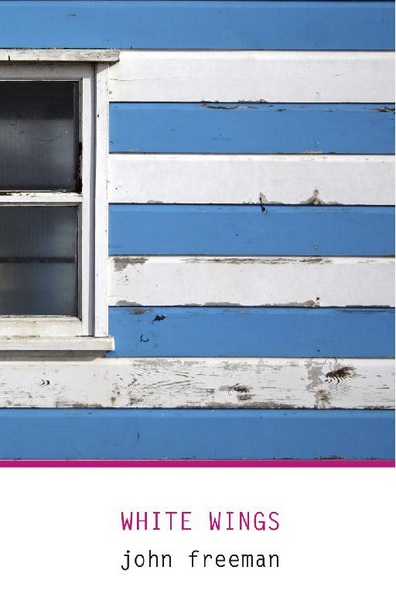
Review of John Freeman's White Wings at Sabotage

I have another review over at Sabotage, this time of John Freeman's fascinating collection White Wings.

freeman

Saturday, February 15, 2014

Why Write Reviews?

As you can see, the title of this blogpost asks a straightforward question. Sadly, the answer may not be so straightforward.

The question arises, however, from a recent review of my own pamphlet Gaud, where the very thoughtful and often sharp-eyed reviewer finds himself puzzled by a poem called 'Serial Killer Review'. This is actually a found poem of sorts, which does not name its various sources - primarily in order to save their blushes. Among other things, it's a parody of poetry reviews, or rather of the kind I saw a lot of when I first started reading poetry magazines: all vague benevolence, no intellectual clout. I wrote that poem quite a while ago, and I have to say that the reviewing I have been encountering recently, especially from young poets and on-line, has much more interesting things to say. That goes for Paul McMenemy's review of Gaud as well, I should add.

Writing for Sabotage, where I also publish reviews, McMenemy wonders if this poem is making an argument 'for the redundancy of all criticism: poems – works of art in general, perhaps – are too personal, perhaps too irrational to be subject to criticism at all, and to attempt to do so is as nonsensical as to attempt to review an act of violence.' My initial reaction to this would be to say that the poem isn't making an argument at all, but is rather being a poem. Unpopular though it is, I believe very strongly that art does not take positions, make arguments, or propose a thesis. This may sound disingenuous from someone who is often told his work is 'political' in some way. But if I wanted to do make an argument, I'd write an essay or a blogpost (like this one) and tell you what I thought.

My preferred way of looking at poetry (and all art) owes much to what Niklas Luhmann had to say on the subject. Namely, that art is not the world, but that it implies the world; it lives from that tension between being something other than reality and at the same time forcing us to see reality in relation to it. So, a poem like 'Serial Killer Review', which is really more of an extended joke, if I'm honest, does at least have the virtue (I hope) of making us ask the question about the value of poetry reviews. It doesn't offer an answer to that question, or even formulate the question in any direct way, but it does attempt to open a space where a number of ideas are in play. The poem itself doesn't really have anything definitive to say on the matter in hand, has no message or judgement to impart.

However, I do have something to say about reviews and the purpose of writing them (this is me speaking now, not my poem). And, it goes like this.

There are five reasons, for me, to spend time writing reviews:

1. To get free books.

Okay, the amount of time and effort you put into a review more or less cancels that argument out, especially when you are doing it for the love. Still, free stuff is still (on some level) free stuff.

2. To shape taste.

This is not a strong point for me, as my taste is pretty omnivorous and I have no doctrinaire commitment to a vision of what 'real' poetry should be or is. Still, if you feel strongly about what is good and want to encourage those poets who share that feeling, and want to encourage readers to share it too, reviewing is one way to try to do that.

3. To be in the right.

We all like to be in the right, I suppose, and reviewing does bestow on the writer a certain position of authority. It's their place to judge, after all - their opinion is what counts. If only until the end of the review.

4. To be part of the scene.

In the increasingly inter-connected world of Twitter, Facebook and so on, reviewing can also be a great way of getting to know people. You review their book, they get in touch and say thank you. That's a nice feeling, too. Although, the awkwardness of encountering someone whose work you've been unpleasant about in the relatively small scene of poetry would be considerable. There is a solution to this, however. I think that there's something interesting to say about most books, even if they are not to my taste. So, the reviewer can talk about those interesting things, even while being critical of other aspects. If that criticism is precise and well-founded, no offence need be taken. Really, it's about meeting the book on its own terms.

5. To be a better reader.

There is a lot to read, let's face it, and not so much time to read it in. Because the books a reviewer receives are generally not ones s/he has chosen, the process forces you to engage with material that can sometimes be quite far from what you would normally buy yourself. If you are taking into account some of what I said in point 4 above, then you will be trying to meet the book on its own terms, trying to see where it is coming from, trying to see whether it lives up to its own ambition (it surely must have some). This means reading, re-reading, a fair amount of travelling around with the book in your bag or walking about the house with it under your arm. The reviewer is trying to make sense of an experience, the experience of reading, which in other circumstances is easy to pass over. We read one book, open another, often we don't give ourselves time to think. Reviewing makes you give yourself that time, and that is a pleasure. As for the audience, the best you can hope is that a person who reads the review seeks out the book and develops their own relationship with it, perhaps even informed by your own experience, and that this relationship will go beyond the superficial as well.

Frankly, what counts for me is point 5 in the list. Maybe that doesn't justify reviewing as a practice, since this only makes it a public service to a limited extent. Still, in a world where so many good books have few readers, the fact that they get a few really attentive ones - the reviewers - seems valuable enough in itself.